
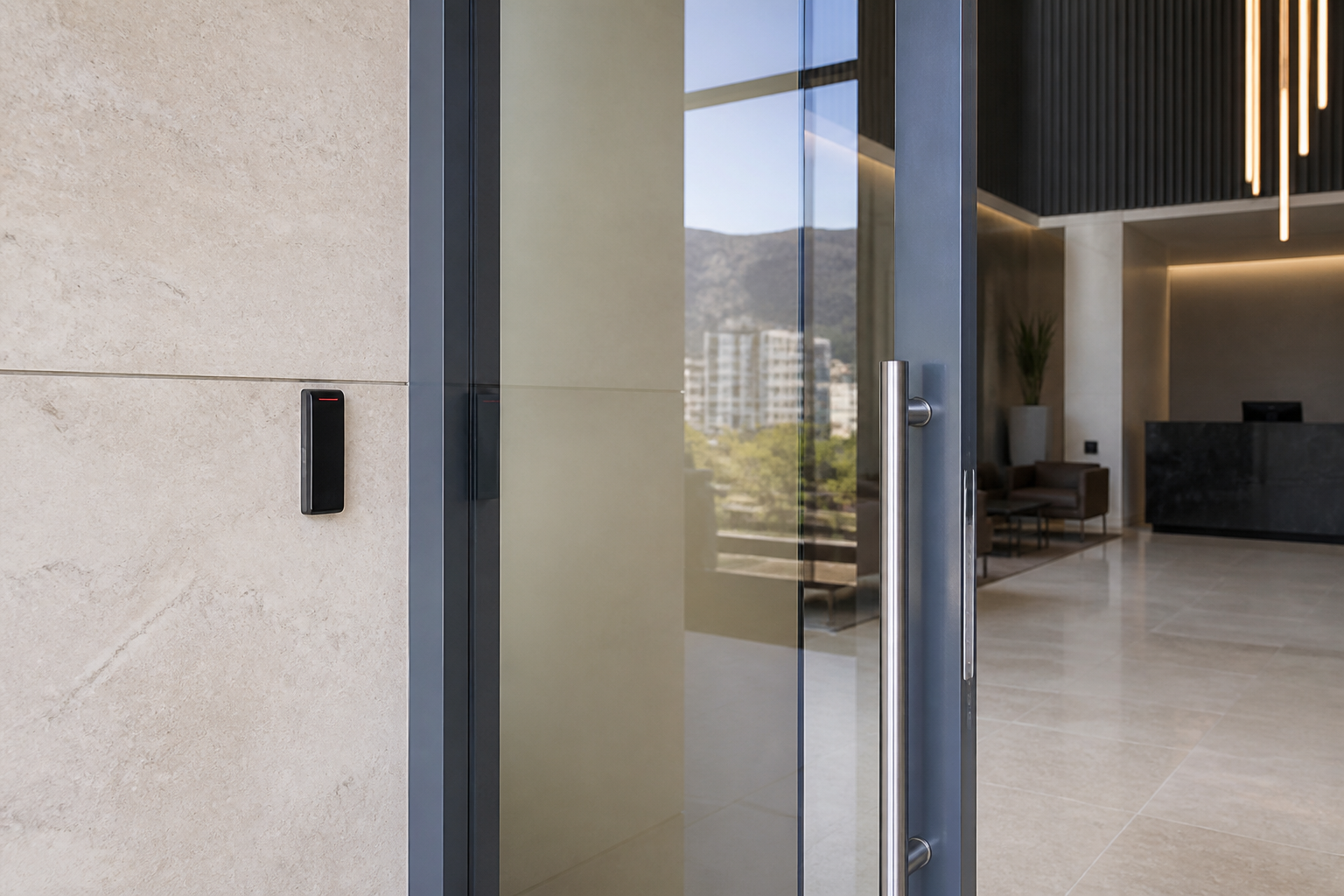
Access Control
RFID and Card Access Control for Daily Building Use
Guidance only. Verify any statutory or insurer requirement against current official South African sources. CapeCore does not publish unverified legal claims.
What RFID access is
A proximity card or tag carries an identifier. The reader energises it at short range and the controller checks whether that ID may open the door. 125 kHz and 13.56 MHz cards are both common; they are not interchangeable. Encrypted smart cards are harder to clone than older unencrypted tags.
Why cards beat unmanaged keys
A lost card is deleted in software. A lost brass key may mean new cylinders on every door. Cards also create an event log: who presented a credential, and whether the door opened. That log is only useful if time is correct and names are kept up to date.
PINs and dual factor
A PIN on the same reader helps if a card is lent. Dual-factor (card plus PIN) is slower at peak but stronger on a plant-room door. Do not print PINs on the card.
Enrolment and leftovers
Contractors, cleaners and last year’s intern are the usual holes. CapeCore sets up card systems so a facilities person can enrol and disable users. We do not leave a master card undocumented.
Related reading
Next step
Request a quote
Tell CapeCore about the property and the systems you need assessed.